Rock 'n'Rogue
Guitar Hero meets FTL, with Balatro-style build synergies.
A pixel-art roguelike rhythm game. Drive a broke, unknown band across the country — San Diego to Providence — to crash the Battle of the Bands. Randomized routes, between-gig encounters, shop loot, and a build that snowballs from one gig to the next.
Every gig is a 5-fret note highway. Real guitar-controller support, custom trapezoid notes, and a streak you can ride — or blow.
A two-layer map under constant time & resource pressure. The tour bus is your ship; the BOTB date is the jump clock you're always racing.
Bandmates are jokers — passive multipliers that synergize, where slot order changes everything. Bosses are blinds that break specific builds.
San Diego to Providence, against the clock.
Every run is the same shape and never the same trip. You pick a loadout, start broke in San Diego, and route your way east across 9–12 states toward Providence's Battle of the Bands. Each state is its own little FTL sector: tour it, play your three gigs, and get out before the departure deadline.
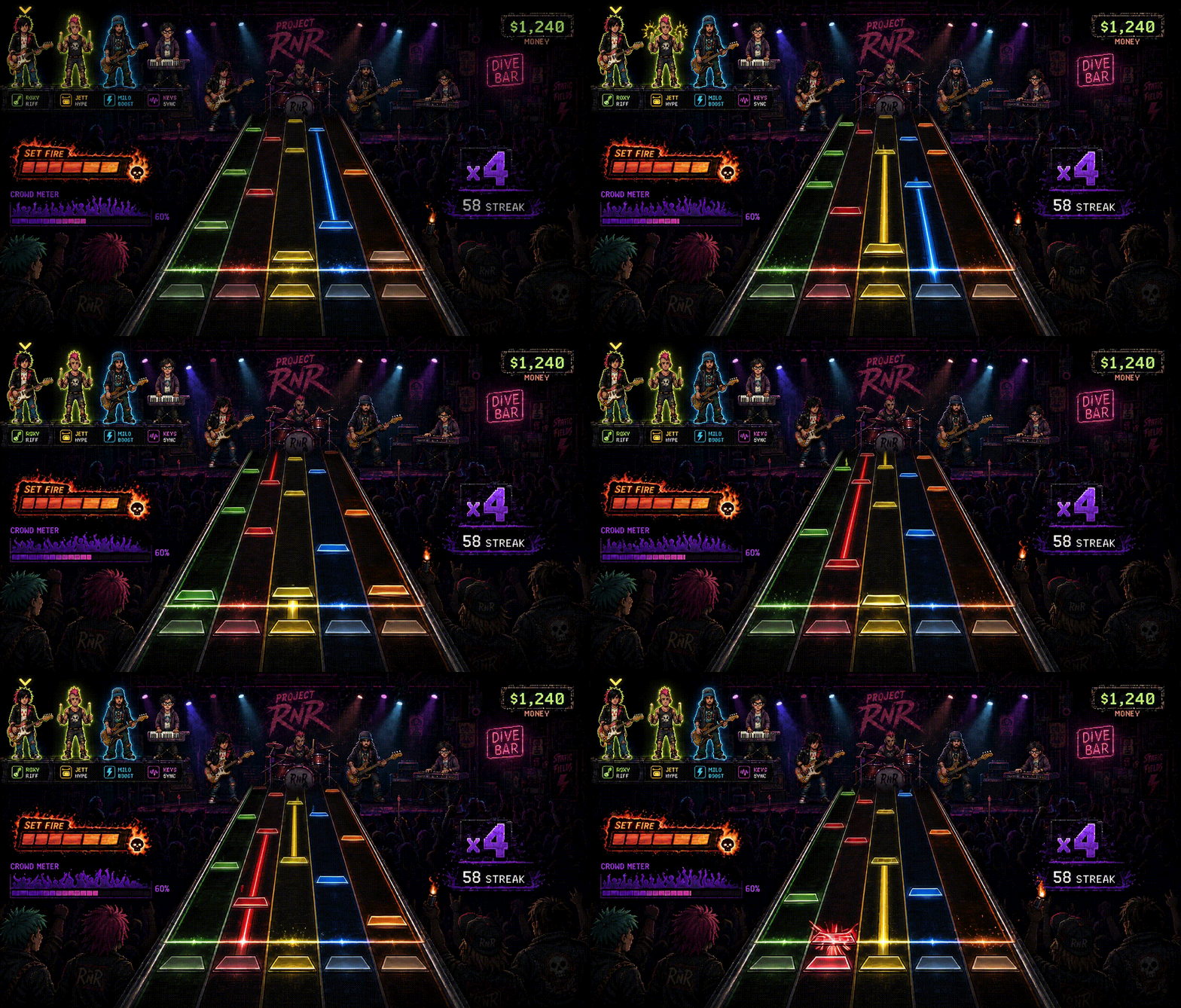
This is the feel. Notes are custom trapezoid bars — closer to fretboard inlays than round gems — chosen for cleaner timing readability and a look that's our own.
The Battle of the Bands has a fixed scheduled date — a run-wide countdown that makes routing a real tradeoff instead of a grind. You can't hit every state and milk every gig. Highway routes let you skip a single state for north/south variance, but they're flexibility, not a shortcut — you still play 9–12 states. Miss a state's departure deadline with fewer than 3 gigs done, and your manager cancels the tour. That's the fail state: no death screen, just a contract torn up.
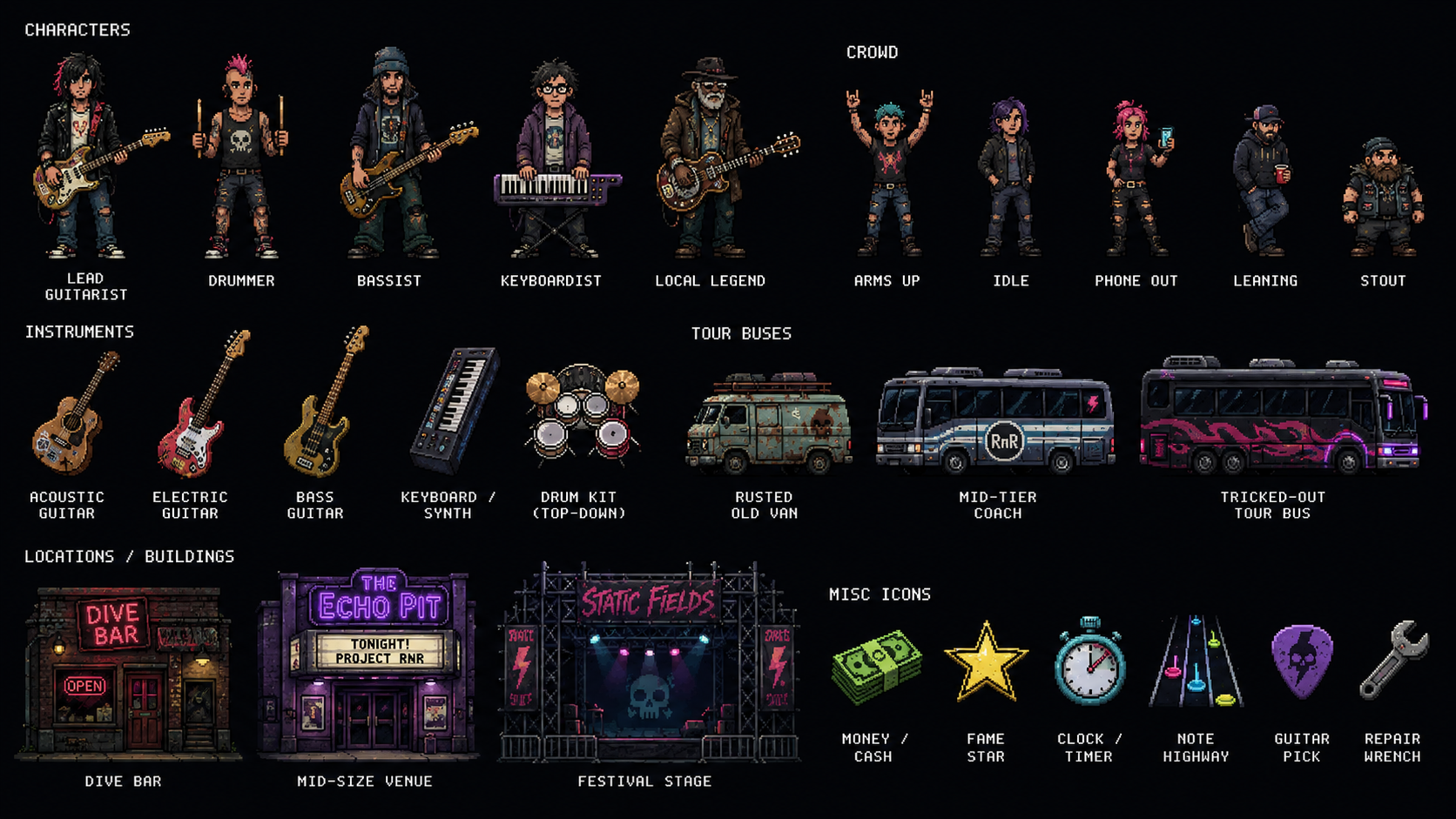
A gritty, scrappy-indie pixel world.
Dark backgrounds, punchy neon, dive bars and tour buses held together with duct tape. The band, the crowd, the gear and the venues all live in one consistent style. Note: All images below are AI mocks that represent general tone, mood, and flow. These images do not reflect final art style.
Four screens, four systems.
Here's the game as it actually reads — the loadout you build, the country you cross, the state you tour, and the gig you play. Click any screen to blow it up full-size.
LoadoutRun start · "Ships" in FTL
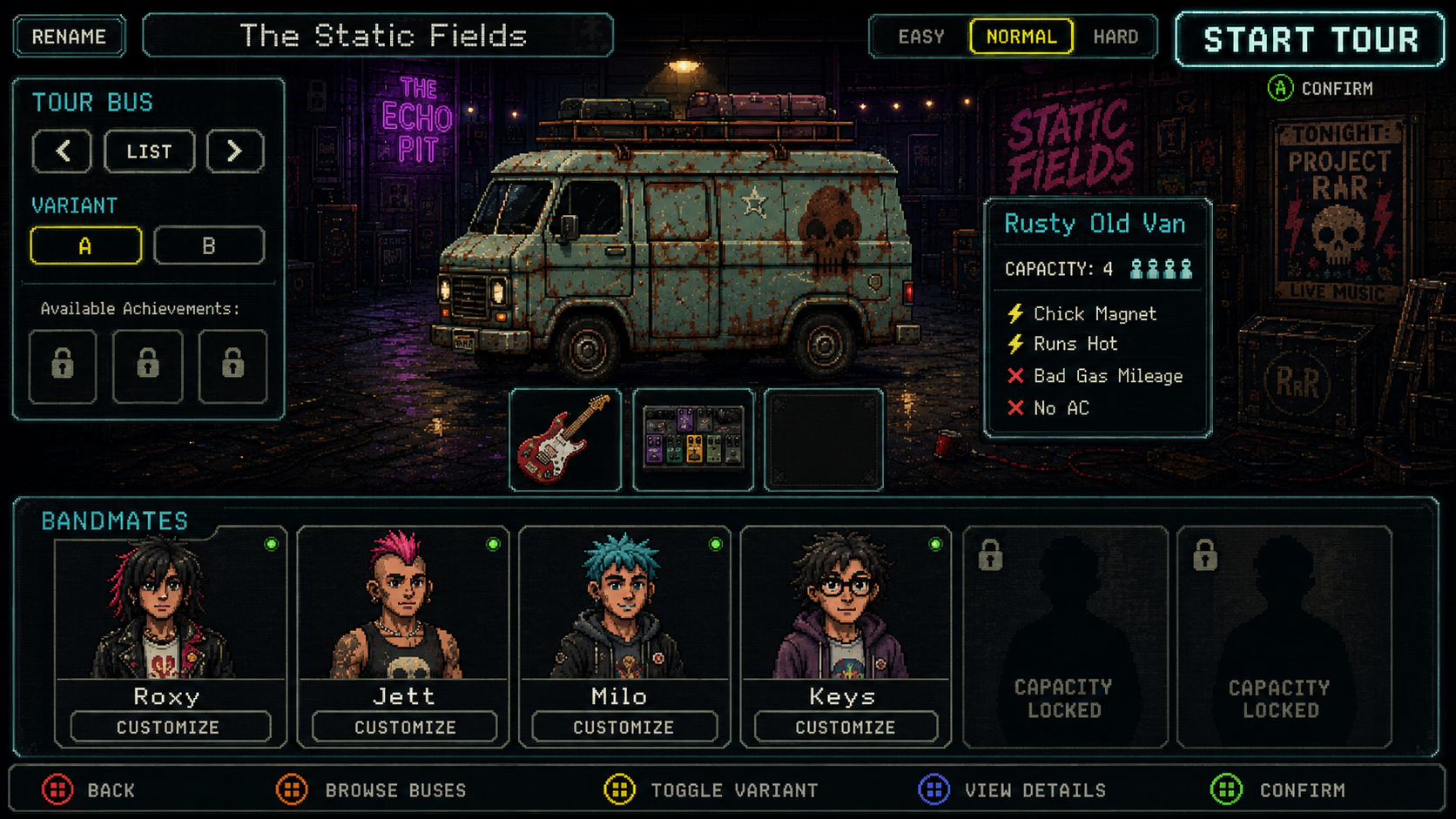
Before you roll, you pick a tour bus — the FTL ship equivalent. It sets your bandmate capacity, gear slots, and a package of travel traits: the Rusty Old Van seats four, carries three pieces of gear, and comes with perks and curses alike — "Chick Magnet" and "Runs Hot" next to "Bad Gas Mileage" and "No AC."
Each bus has unlockable Variants (A / B) that swap the whole trait package. Then you slot bandmates — your Balatro jokers — into the capacity the bus allows (here, 4 active, 2 capacity-locked). Your hero starts on a humble 3-chord guitar that literally gates the song pool until you upgrade it.
 Click to enlarge
Country MapThe journey · FTL galaxy map
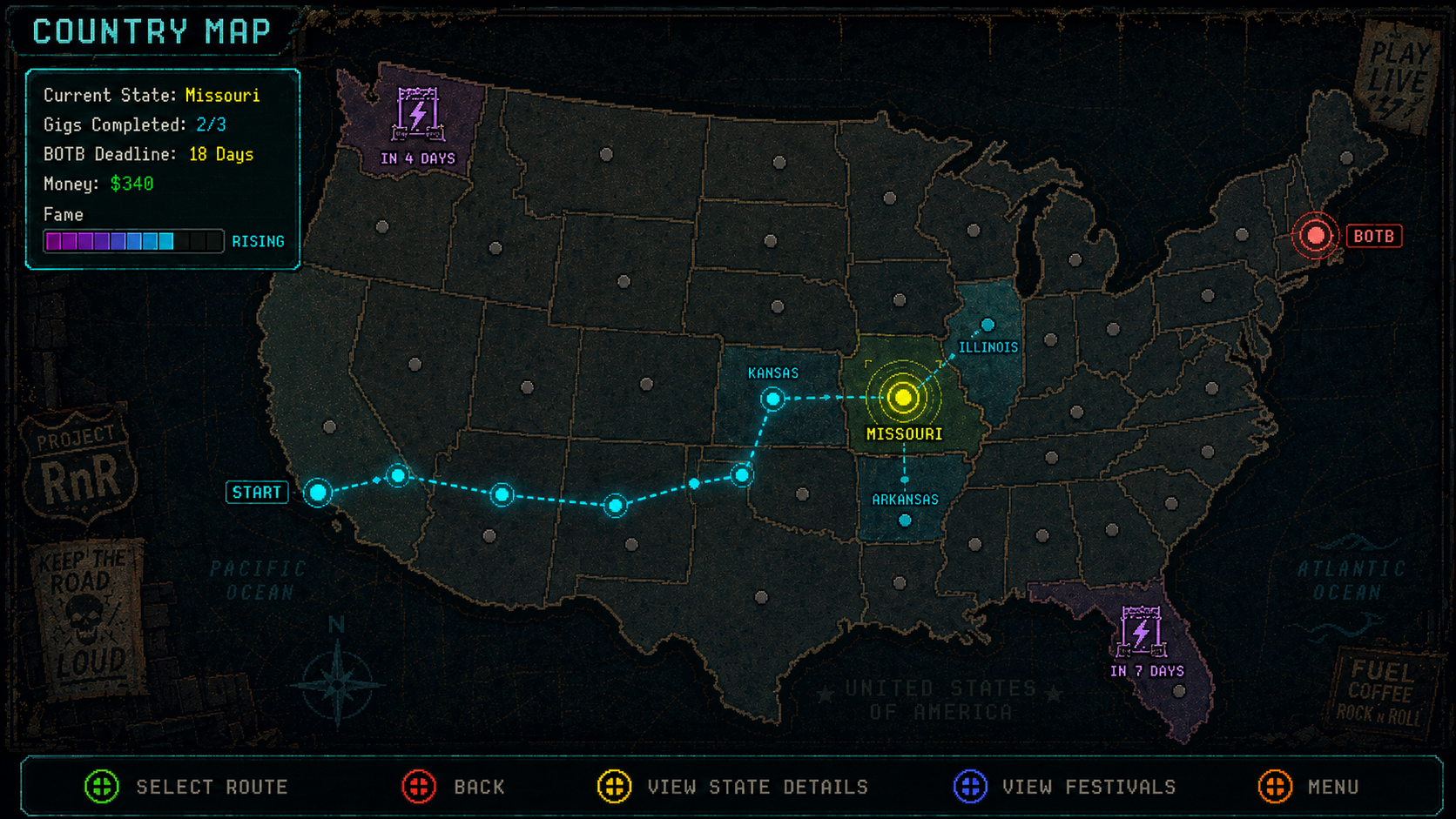
A worn road-atlas of the continental US, fully visible from the first second of the run. You plan your route state by state — the traveled path draws a connected trail, and only the directly reachable next states are labeled. Providence sits in the corner as the fixed red BOTB endpoint, with its deadline ticking in the HUD.
Two purple festival nodes float off-route with "IN X DAYS" countdowns — date-locked detours dangling outsized rewards, daring you to bend your path. Over multiple runs, map icons fill in permanently: a pawn shop you discover in Tennessee shows up on every future map, courtesy of the Contacts system.
 Click to enlarge
State MapThe detour · FTL sector map
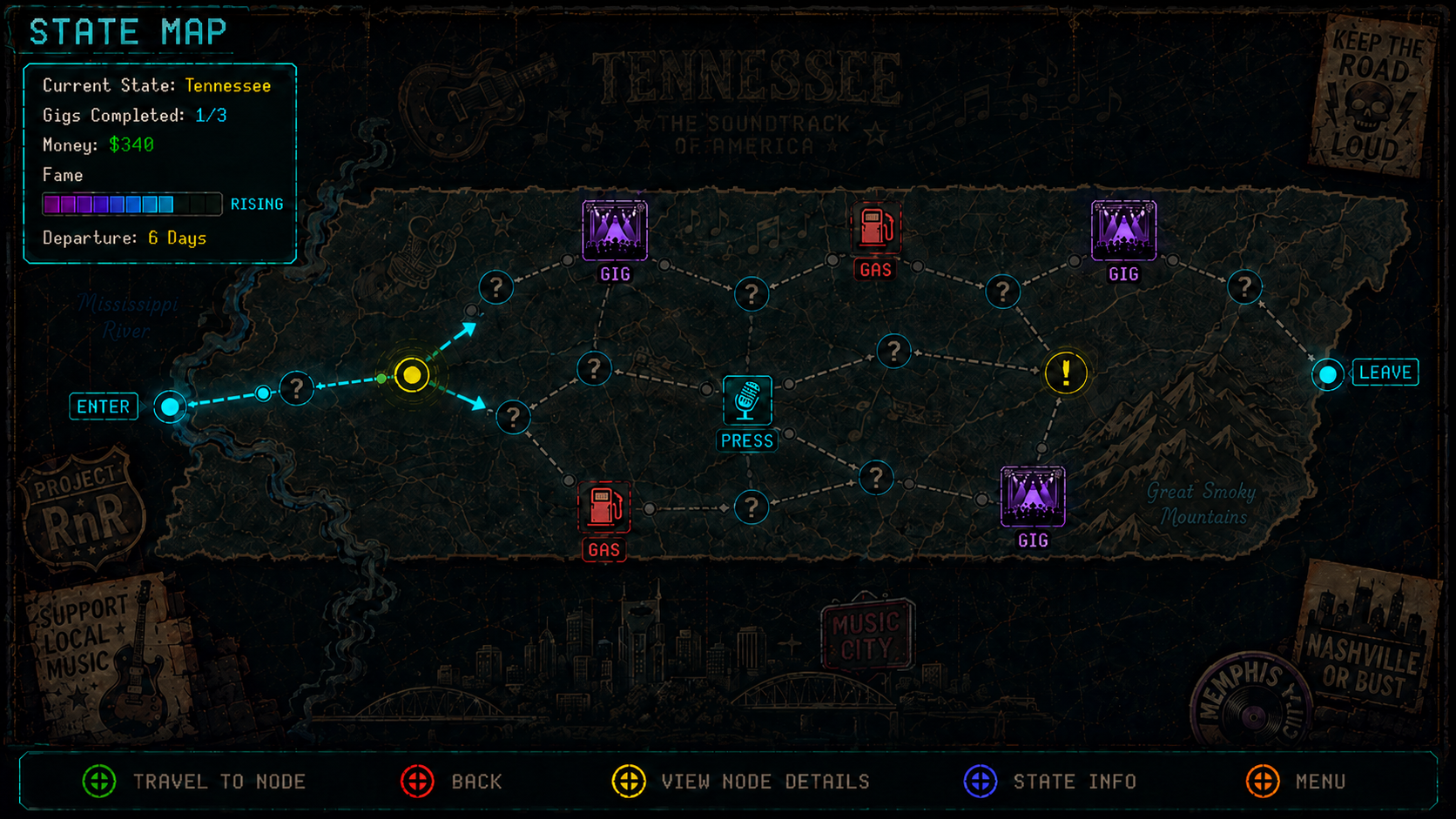
Drop into a state and it's a branching node web — ENTER on the left, LEAVE on the right, choices fanning out between. Most node contents are fogged: a "?" only reveals what it holds once you commit to traveling there. Gig venues, gas stations, and press events show their type up front; you need three gigs done before departure.
The yellow "!" node is partial intel — you overheard something's there, but not what. It could pay off or bite.
 Click to enlarge
Gig GameplayThe action · the note highway
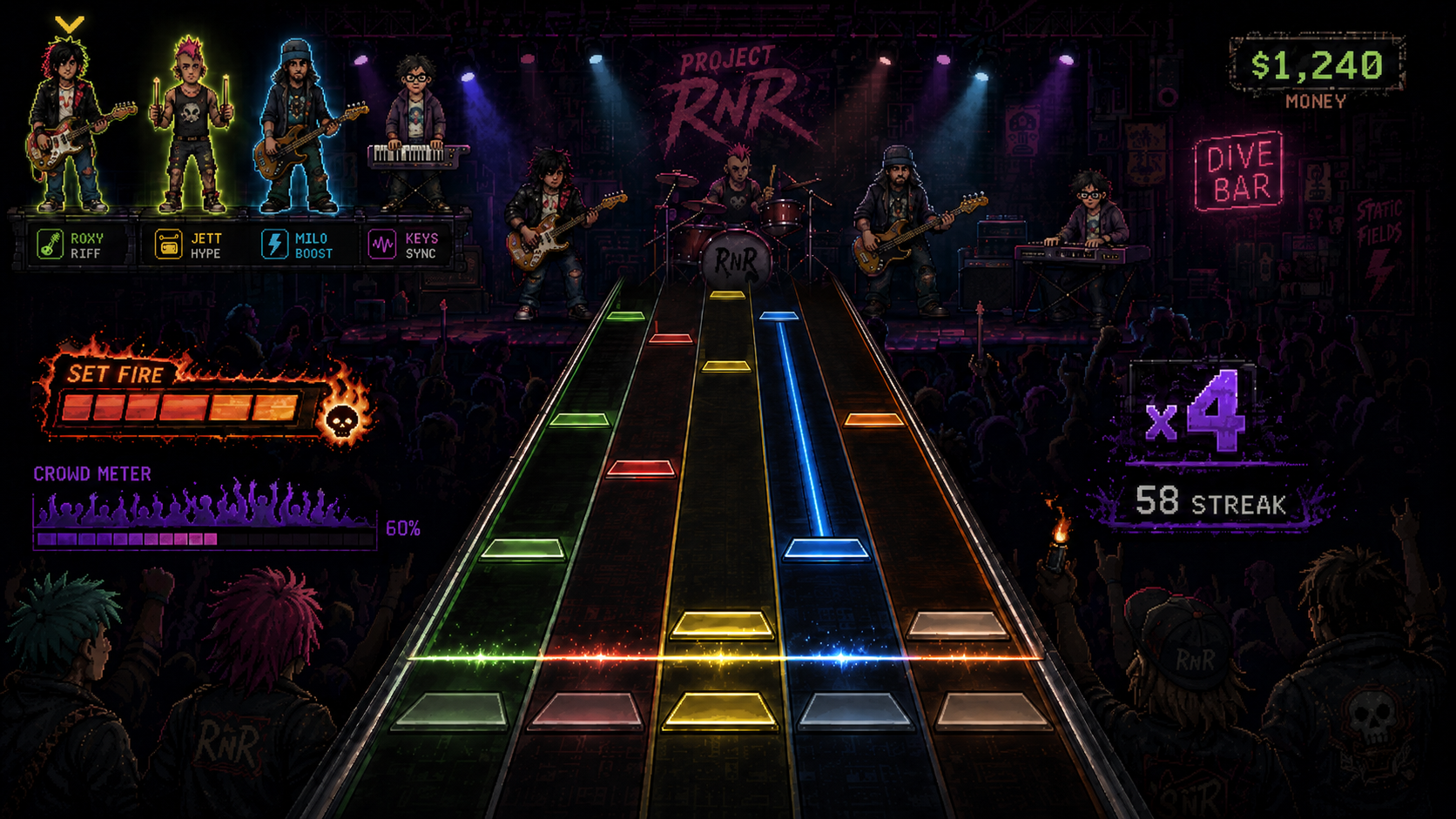
The core action: a five-fret highway of trapezoid notes, held notes trailing glowing ribbons. Up top, the band doubles as the ability HUD — a chevron marks who's active, and ready abilities light up. The flaming SET FIRE gauge is your star power; the crowd meter tracks the room, and money, multiplier, and streak read out live.
Score, payout, and fame all flow out of this screen. Nail a full combo and fame rises and the room fills; bomb it and the set gets cut — less money, fame down. This is where the whole build either pays off or falls apart.
 Click to enlarge
What's under the hood.
The systems that turn "rhythm game" into "roguelike." How a gig becomes money, how a band becomes a build, and what's trying to break it.
The Three-Layer Scoring Stack
A gig's payout is built in three stacked layers — your skill sets the floor, your build multiplies it, and the venue sets a semi-random ceiling. Same performance, wildly different take.
Star Power & Slot Order
Bandmates can carry an active ability on a cooldown, triggered by the charged SET FIRE gauge. Each trigger fires the currently active member's ability, then advances to the next in slot order — so the order you place them is the order they fire, pure Balatro joker logic.
The catch: if the active member is on cooldown, you can't trigger at all — even if the next one's ready. Slot ordering becomes a real strategic decision.
Fame
Fame is a track, not a currency — you never spend it. It feeds Layer 3 turnout: the more famous you are, the bigger the room, the bigger the take on an identical set.
Bosses vs. Festivals
Two distinct systems that used to be one. Bosses are the guaranteed wall; festivals are the optional gamble.
Boss Fights
- Guaranteed and gating — current plan: every 3rd state, at least 3 per run.
- Apply weird modifiers — no streak bonuses, hammer-ons only, delayed highway, hostile crowd, gear disabled.
- Asymmetric by design: "no streak" is brutal for streak builds, irrelevant for raw-note builds.
- The BOTB in Providence is the ultimate one — max modifiers.
Festivals
- Appear randomly on the country map, each tied to a fixed in-game date ("IN X DAYS").
- A routing puzzle on top of the BOTB clock — you must arrive on time.
- Drop outsized rewards — tempting enough to bend your whole route around.
- Excluded from California and Rhode Island (start / end).
The Intel System
Intel is knowledge that carries between runs, separate from unlocked content. Background characters can kick off quest chains that ultimately hand you a permanent lead — the location of a secret venue that pays absurdly well.
Run-to-Run Progression
Current design state.
Designed & Locked
ConfirmedDecisions that are settled and load-bearing.
- The three-pillar identity — Guitar Hero action, FTL journey, Balatro build.
- San Diego → Providence, fixed start and end; BOTB as the run-wide clock.
- Two-layer map — country (galaxy) and state (sector), with fog-of-war nodes.
- Loadout structure — bus + Variants, bandmate capacity, gear slots, hero instrument-gating.
- Three-layer scoring stack and the Fame turnout model.
- Star-power framework — slot order = trigger order, cooldown gating.
- Bosses vs. Festivals split into two distinct systems.
- Intel & Contacts as the run-to-run meta-progression spine.
Still in Design
In progressSystems with a direction set but the details not yet pinned down.
- Festival gameplay loop — the moment-to-moment (likely a decision chain, skill checks, and a miniboss) isn't designed yet.
- Band-member ability pool — the trigger/cooldown framework is set; the actual roster of abilities is not.
- Rivals mechanic — blocking venues and sabotaging turnout are noted, but the underlying mechanic is unwritten.
- State map scope — a universal node-layout system is the likely path; bespoke per-state illustrated maps remain aspirational.
- Morale system depth — road-vs-hotel is established; the full morale mechanic isn't yet defined.
- Boss placement & rarity tiers — "every 3rd state" and Balatro-style bandmate rarities are directional, not final.
- Song licensing vs. original tracks — not yet discussed; shapes scope, tone, and budget.